How healthy horses and donkeys support stronger livelihoods
Keeping working animals healthy also helps communities to thrive. Learn more about the hidden contribution of donkeys, horse and mules to households, livelihoods and economies, and the cost of poor animal health.
Invisible animals
The hidden contribution of working animals
Horses, donkeys and mules support families and economies across the world. They transport water, food and goods, enabling millions to survive and thrive. Yet, until recently, their true economic value was invisible, and the cost of their poor welfare unknown.
Brooke is researching how healthy working animals help households, communities and national economies. We worked with the Global Burden of Animal Diseases (GBADs) programme and the International Livestock Research Institute (ILRI) to study working donkeys in Ethiopia.
The findings are transformative:
- Donkeys contribute the equivalent of $2.2 billion (USD) per year to Ethiopia’s economy
- They also have a vital role in human development and help families to save time and money
- Money saved helps pay for essentials, such as food and education
- The time saved enables women to generate their own incomes, and girls to attend school.
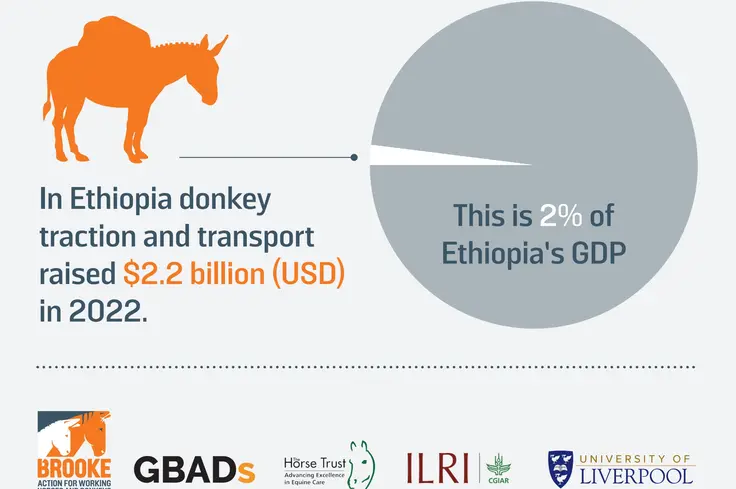
Our study is the first to provide a monetary value for the unpaid work donkeys assist with. Meaning that, for the first time, the true extent of their economic contribution can be seen.
A donkey at Shashamene Market, Ethiopia

Economic impact
The cost of poor animal health
Horses, donkeys and mules can only support families when they are in good health and have high welfare standards.
The research also measured the economic impact of injury and disease, which includes:
- In Ethiopia losses from donkeys' diseases, wounds and lameness, amounts to $646 million (USD) a year
- Sick donkeys also mean households need to spend up to an extra 16 hours a week doing household chores. This has the biggest impact on women and girls, who are often responsible for such tasks.
The success of Brooke's campaigning
Our study shows the importance of healthy working animals. We are sharing the results with Ethiopian ministries, global and regional organisations like the United Nations and African Union and other International Non-Governmental Organisations (NGOs).
Through Brooke's advocacy and campaigning, this research is changing how working donkeys are viewed. When politicians and those with influence recognise the importance of healthy working donkeys, they are seen and valued and in turn, can be included in laws and guidelines that will improve their welfare.
Next steps
We are continuing to partner with the Global Burden of Animal Diseases (GBADs) programme (now based at The University of Edinburgh) and the International Livestock Research Institute (ILRI). Expanding the research to more countries, and situations where Brooke works, means we can also include horses and mules. More evidence makes our work stronger, leading to better results for working horses, donkeys and mules.
Explore our impact
Every action we take focuses on improving the lives of working horses, donkeys and mules.

What we do
Brooke works with communities across the world to transform the lives of working horses, donkeys and mules. We drive lasting improvements in animal health and welfare through action, advocacy and education.